On 23 January 2027, the musical world marks 190 years since the death of John Field, the Irish pianist-composer whose name is inseparable from the birth of the Romantic nocturne. Field did not simply provide Chopin with a model: during three decades in the Russian Empire, he created a new kind of intimate piano music and helped shape the culture in which a Russian school of pianism and composition could emerge. His nocturnes remind us that musical genres rarely belong to a single nation; they travel through performers, pupils, publishers and drawing rooms.
Frédéric Chopin’s nocturnes now dominate the concert platform, but listeners in the early nineteenth century would first have associated the genre with Field. Born in Dublin in 1782 and trained in London by Muzio Clementi, Field travelled with his teacher through Paris and Vienna before reaching St Petersburg in 1802. Clementi left; Field stayed. Russia became the centre of his adult career, as he moved between St Petersburg, Moscow and aristocratic country estates, earning his living as a concert pianist and highly sought-after teacher[1].
To call Field the „inventor” of the nocturne is convenient, but it needs qualification. The word notturno had already described eighteenth-century evening music, often for ensembles, and elements of the later piano texture existed before Field. His decisive innovation was to bring a particular sound and poetic idea together in compact works for solo piano published as nocturnes. The first appeared in St Petersburg in 1812; editions issued elsewhere in Europe soon carried the genre across borders[2].
That sound is immediately recognisable. A long, singing melody floats above widely spaced broken chords, while the sustaining pedal allows harmonies to blur gently into one another. Ornament is not mere display: turns, filigree and improvised-sounding runs make the melodic line breathe. The form is often freer than a Classical sonata movement, and the emotional world is private rather than theatrical—elegiac, tender and suspended between song and reverie. Carl Czerny later compared the nocturne’s construction to a short slow movement from a sonata, but Field made that inward moment independent[3].
The style was inseparable from Field’s playing. Contemporary accounts emphasised his legato, refined touch and unusually quiet physical manner at the keyboard. At a time when public virtuosity increasingly rewarded brilliance and spectacle, he demonstrated another kind of command: the ability to make the piano sing. This mattered in Russian salons, where close listening, amateur music-making and professional performance overlapped. A nocturne could work as a sophisticated concert piece, a private meditation and a model for advanced pupils.
Russia, then, was not a colourful background to an essentially Western European invention. It was the environment in which Field’s mature style developed. His earliest nocturnes were printed in St Petersburg, and his livelihood depended on Russian audiences, patrons and students. Recent scholarship has gone further, interpreting the genre through the long winter darkness and luminous northern summer nights of St Petersburg, while carefully acknowledging that direct testimony from Field himself is scarce[4]. Whether or not a particular landscape can be heard in a particular bar, the nocturne emerged from a life lived between Irish birth, London training and Russian practice.
Aristocratic salons were central to this musical environment. The gatherings associated with the Vielgorsky brothers in St Petersburg illustrate how private patronage brought professional musicians, composers and cultivated amateurs into contact. Such spaces were more than venues for entertainment: they facilitated the exchange of repertoire, encouraged musical experimentation and connected performers with influential patrons. The nocturne, with its intimate character and emphasis on expressive playing, was particularly well suited to this world, where the boundaries between domestic music-making and professional performance remained fluid.
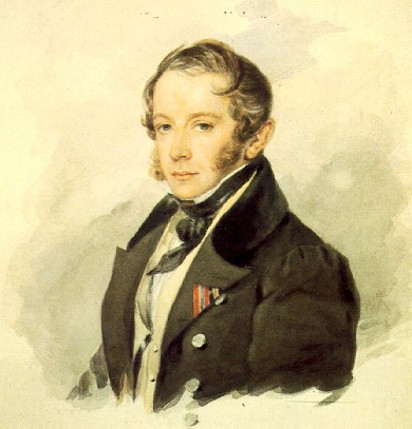
Count Mikhail Vielgorsky (1788–1856), a prominent patron of musical life in nineteenth-century St Petersburg. Portrait by Pyotr Sokolov (Wikimedia Commons)
Publication gave this intimate music an unexpectedly wide reach. Field revised pieces repeatedly, and publishers in Russia, France, Germany, Austria and Britain issued them in changing groups and sequences. A work heard in a private St Petersburg room could therefore become a commodity for pianists who had never encountered Field in person. The process also blurred the boundary between composition and performance: written editions preserved the outline of a style that contemporaries experienced through his flexible timing, pedalling and improvised ornament. The nocturne’s spread depended as much on print and pedagogy as on the originality of its creator.
Field’s teaching spread that practice through personal contact. Pupils and admirers absorbed not only his arpeggiated textures but also his ideal of cantabile playing. Ivan Laskovsky, a gifted Russian pianist-composer who studied with Field, wrote nocturnes whose lyrical melodies and balanced forms remain close to his teacher’s example. Charles Mayer, another Field pupil and later a teacher of Mikhail Glinka, carried the same concern for tone and phrasing into the next generation. These networks complicate the familiar story in which Russian art music suddenly begins with a few canonical nationalist composers.
Glinka’s case is especially revealing. He studied briefly with Field and more extensively with Mayer. His E-flat-major Nocturne of 1828 and La Séparation of 1839 retain the genre’s singing line and gently articulated accompaniment, yet the later work speaks in Glinka’s own concentrated language of leave-taking. The melody is not simply laid over a generic pattern; it unfolds like a wordless romance. Field’s model was therefore not a mould that erased individuality. It offered a flexible way to organise lyric feeling at the keyboard[5].
Other composers working in the Russian Empire extended the genre in different directions. The amateur pianist-composer Alexander Lizogub wrote salon nocturnes in E-flat and A-flat major; Adolf von Henselt united lyrical sonority with a more expansive virtuoso technique; Nikolai Zaremba and Anton Rubinstein treated the nocturne as a vehicle for sustained melody, tonal contrast and instrumental colour. Even when their pieces preserve the familiar right-hand song over a rippling left hand, they reveal different levels of technical ambition and different relationships between domestic and concert music. My doctoral research examines these works as part of a wider „Fieldian” tradition, revealing how composers adapted the nocturne to their own musical environments rather than merely reproducing their teacher’s models[6].
Chopin transformed the nocturne more radically than any of them. He intensified its chromatic harmony, expanded its dramatic range and made ornament part of an unmistakably personal rhetoric. Yet the comparison has too often reduced Field to a preliminary sketch of a greater composer. That judgement reverses historical perspective. Field established the nocturne as a publishable, teachable and internationally recognisable mode of expression before Chopin’s first set appeared. Chopin did not rescue an incomplete idea; he entered a genre that already had a history[7].
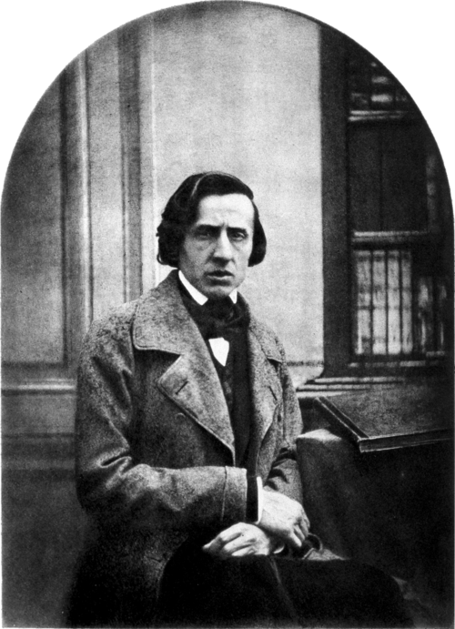
Frédéric Chopin, 1849. Photograph by Louis-Auguste Bisson (Musée de la Musique / Wikimedia Commons)
Field’s influence also reached beyond pieces bearing the title „nocturne”. The ideal of a self-contained lyrical piano miniature fed the nineteenth century’s appetite for romances, songs without words, impromptus and other character pieces. His approach to touch and pedalling helped define a poetic alternative to percussive display. Editions continued to reshape his legacy after his death, sometimes renumbering pieces or relabelling pastorales, romances and other works as nocturnes. The familiar total of eighteen therefore reflects a complicated publication history rather than a single, fixed collection authorised in that form by the composer[8].
Field died in Moscow on 23 January 1837. The 190th anniversary invites more than a ceremonial revival. It asks us to hear the nocturne before it became shorthand for Chopin: as an experiment in sonority, an object of salon culture and the product of migration across Dublin, London, St Petersburg and Moscow. It also restores Russia’s early nineteenth-century musical life to the story. Long before conservatoires institutionalised professional training, teachers, aristocratic amateurs, touring virtuosi and publishers were already building networks through which styles circulated.
The most lasting feature of Field’s nocturnes is not a formula but a mode of attention. Their apparent simplicity depends on control of line, balance, timing and resonance. They ask the pianist to replace display with listening, and the listener to notice how little material is needed to create an atmosphere. One hundred and ninety years after Field’s death, that quiet revolution can still sound new.
_________
[1] P. Piggott, The life and music of John Field, 1782-1837: Creator of the nocturne, Faber and Faber, London 1973; M. Boland, John Field’s Russian landscape and the early nineteenth-century piano nocturne, „Nineteenth-Century Music Review” 2023, vol. 20(2), pp. 285–304.
[2] D. Rowland, The nocturne: Development of a new style, in: The Cambridge companion to Chopin, ed. by J. Samson, Cambridge University Press, Cambridge 1992, pp. 32–49.
[3] C. Czerny, School of practical composition, vol. 1, transl. by J. Bishop, Robert Cocks, London 1848; John Field: Nocturnes and related pieces, Musica Britannica, vol. 71, ed. by R. Langley, Stainer and Bell, London 1997.
[4] M. Boland, John Field’s Russian landscape…, op. cit.
[5] V. Ryabchikov, Notes to Mikhail Glinka: Complete piano music (Vol. 1) [CD booklet]. BIS 1998; M. Boland, John Field’s Russian landscape…, op. cit.
[6] This paragraph develops the author’s ongoing doctoral research at the University of Birmingham.
[7] D. Rowland, Thenocturne…, op. cit.
[8] M. Boland, John Field’s Russian landscape…, op. cit.; C. Hopkinson, A bibliographical thematic catalogue of the works of John Field, 1782-1837, Privately printed, London 1961.